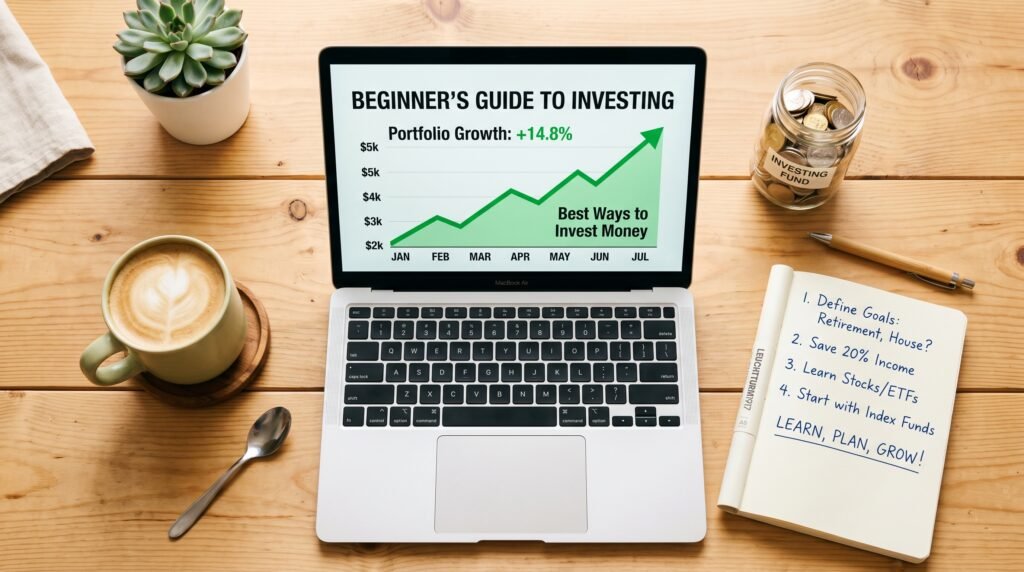
Investing can feel confusing when you are just starting out, but it does not have to be. In this simple guide you will learn the 5 best ways to invest money in the market in 2026 — explained in plain English, with real examples and a free YouTube video for each strategy so you can watch and learn at your own pace.
You do not need to be rich or an expert to begin. You can start with a small amount, stay consistent, and let time and compound growth do the heavy lifting. Let’s break it down.
What you’ll learn
- Index Funds & ETFs — the easiest place to start
- Dividend Stocks — get paid to hold
- REITs — real estate without buying property
- Bonds — the steady, low-risk option
- Robo-Advisors — let an app invest for you
- Quick comparison table
- Frequently asked questions
1. Index Funds & ETFs — The Easiest Place to Start
An index fund (or its close cousin, the ETF) is a single investment that automatically buys a tiny piece of hundreds of companies at once. Instead of guessing which one company will win, you own a slice of the whole market. The most famous example tracks the S&P 500, which is the 500 largest companies in the United States.
This is the favourite strategy of beginners — and even of legendary investor Warren Buffett — because it is cheap, simple, and spreads your risk automatically.
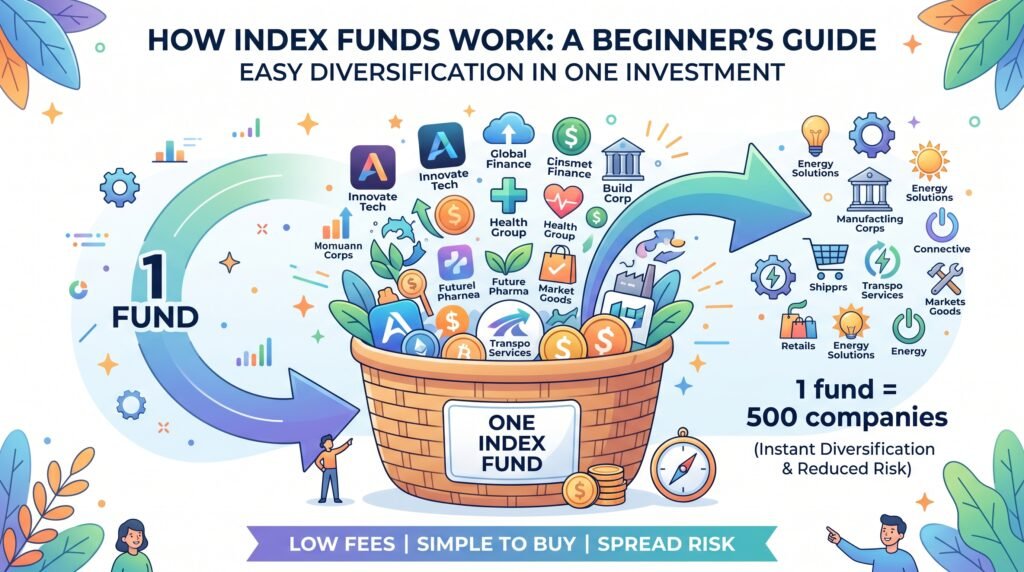
Practical example: Imagine you invest $200 every month into an S&P 500 index fund. Historically the market has returned around 7–10% per year on average over the long run. At an 8% average return, that $200/month could grow to roughly $118,000 in 20 years — even though you only put in $48,000. That extra growth is the power of compounding.
✅ Pros
Low cost, instant diversification, very little research needed, beginner-friendly.
⚠️ Cons
Returns follow the market (no shortcuts), value goes up and down in the short term.
▶ Watch & learn (English)
Index Funds and ETFs Explained — How to Start Investing for Beginners
2. Dividend Stocks — Get Paid Just for Holding
A dividend stock is a share in a company that pays you a small cash reward — a “dividend” — usually every three months, simply for owning it. Many large, stable companies (think household names that sell products people buy every day) share their profits with shareholders this way.
It is one of the most popular ways to build passive income: money that arrives whether you are working, sleeping, or on holiday.

Practical example: Say you buy $5,000 of a stock that pays a 4% annual dividend. That’s $200 per year paid directly to you in cash — and if you reinvest those dividends to buy more shares, your income snowballs year after year. Many investors aim to eventually live off dividends in retirement.
✅ Pros
Regular cash income, can be reinvested to compound, often from stable companies.
⚠️ Cons
More research needed, individual companies carry more risk than a whole fund.
▶ Watch & learn (English)
Dividend Investing for Beginners — How to Make Your Stocks Pay You
3. REITs — Invest in Real Estate Without Buying Property
A REIT (Real Estate Investment Trust) is a company that owns income-producing real estate — apartments, shopping centres, warehouses, hospitals — and lets you buy shares of it just like a stock. You get to be a “landlord” without ever fixing a leaky tap or chasing a tenant.
By law, REITs must pay out at least 90% of their income to investors, which makes them excellent for steady income.

Practical example: Instead of needing $50,000 for a deposit on a rental flat, you could invest $500 in a REIT that owns hundreds of properties. You earn a share of the rent collected across all of them — often paid as a dividend of 3–5% per year — and you can sell your shares any time, unlike a physical house.
✅ Pros
Low entry cost, real-estate exposure, high dividends, easy to buy and sell.
⚠️ Cons
Sensitive to interest rates, share price can be volatile.
▶ Watch & learn (English)
Real Estate Investment Trusts (REITs) for Beginners
4. Bonds — The Steady, Low-Risk Option
A bond is basically a loan you give to a government or a company. In return, they promise to pay you interest at fixed times and give your money back on an agreed date. Because the income is predictable, bonds are considered one of the safest ways to invest — perfect for balancing out riskier investments.

Practical example: You buy a $1,000 government bond that pays 5% interest per year for 5 years. Each year you receive $50, and at the end of the 5 years you get your $1,000 back. You knew the exact outcome the day you invested — that predictability is why cautious investors love bonds.
✅ Pros
Predictable income, lower risk, adds stability to your portfolio.
⚠️ Cons
Lower returns than stocks, value can fall when interest rates rise.
▶ Watch & learn (English)
Bond Investing Made Simple — Everything You Need in One Video
5. Robo-Advisors — Let an App Invest for You
A robo-advisor is an app or website that does the investing for you. You answer a few simple questions about your goals and how much risk you are comfortable with, and the robo-advisor automatically builds a diversified portfolio of low-cost funds and keeps it balanced over time — all on autopilot.
This is the ultimate “set it and forget it” option for beginners who don’t want to pick investments themselves.

Practical example: You open a robo-advisor account, deposit $100, and set up a $100 monthly automatic transfer. The app spreads your money across stocks and bonds based on your goals, reinvests your earnings, and rebalances everything for you — typically for a small fee of about 0.25% per year (just $2.50 on a $1,000 balance).
✅ Pros
Fully automated, low minimums, hands-off, great for absolute beginners.
⚠️ Cons
Small management fee, less control over individual investments.
▶ Watch & learn (English)
How to Invest in Robo-Advisors — Beginner’s Complete Guide
Quick Comparison: Which Investment Is Right for You?
| Investment | Risk Level | Effort | Best For |
|---|---|---|---|
| Index Funds & ETFs | Medium | Very Low | Almost every beginner |
| Dividend Stocks | Medium–High | Medium | People who want passive income |
| REITs | Medium | Low | Real-estate fans on a budget |
| Bonds | Low | Low | Cautious, safety-first investors |
| Robo-Advisors | Adjustable | Almost none | Hands-off beginners |
Many smart beginners don’t pick just one — they combine several. A common starter mix is mostly index funds, a few dividend stocks or REITs for income, and some bonds for safety.
Ready to start investing?
The best day to start was years ago. The second-best day is today. Pick one strategy above, start small, stay consistent — and let time grow your money.
👉 Explore more beginner guides at Improve Your Money.
Frequently Asked Questions
How much money do I need to start investing?
You can start with as little as $1 to $100. Many apps now offer fractional shares, which let you buy a small slice of a fund or stock. The key is to start early and invest regularly, even with small amounts.
What is the safest way to invest money for beginners?
Low-cost index funds and ETFs are widely seen as one of the safest long-term strategies because they spread your money across hundreds of companies. Bonds are also low-risk and add stability to your portfolio.
Is it better to invest in stocks or index funds?
For most beginners, index funds are the better starting point thanks to instant diversification and minimal research. Individual stocks can earn more but carry more risk and take more time to study.
How do robo-advisors work?
A robo-advisor asks about your goals and risk comfort, then automatically builds and manages a diversified portfolio for you, rebalancing over time — usually for a small annual fee of around 0.25%.
Disclaimer: This article is for educational purposes only and is not financial advice. All investments carry risk, including the possible loss of money. Past performance does not guarantee future results. Please do your own research or speak with a licensed financial advisor before investing.